Choosing the right bike for a young rider involves balancing stability, growth, and safety. This guide showcases five top-rated bikes that suit two-year-olds and up, each offering training wheels, balance modes, or multi-ride configurations designed to develop coordination and confidence. From 2-in-1 trikes to 3-in-1 bikes, these options help children progress at their own pace without needing to buy multiple vehicles.
| Product | Brand | Key Feature |
|---|---|---|
| KRIDDO 2-in-1 Trike And Balance Bike | KRIDDO | 2-in-1 mode with pedal storage; switch between trike and balance bike |
| JOYSTAR Pluto 12-Inch Toddler Bike | JOYSTAR | 12″ wheels; training wheels; adjustable seat; safe chain guard |
| XIAPIA 3-In-1 Toddler Bike | XIAPIA | Pedal, pedal-less, and training wheel modes |
| JOYSTAR 12-Inch Kids Bike With Training Wheels | JOYSTAR | Basket, water bottle, coaster brake, easy assembly |
| JOYSTAR Little Daisy 12-Inch Girls Bike | JOYSTAR | Doll seat, basket, removable training wheels |
KRIDDO 2-in-1 Trike And Balance Bike

The KRIDDO 2-in-1 offers a practical path from stability to balance. In trike mode, it provides a broad base and pedals for early riders who need support learning road rules and coordination. When ready, switch to balance bike mode by storing or detaching the pedals via the rear-seat pedal storage, a clever built-in pedal mount that prevents loss and makes conversion quick. The stowable training wheels can be lifted away or removed entirely, allowing a smooth transition to a classic balance bike as confidence grows. Designed for ages 18 months to 3 years, this bike grows with your child.
Parents will appreciate the dual-purpose design, which reduces the need for buying separate bikes as a child develops. The pedal storage system keeps spare parts organized and minimizes misplacement during the transition from trike to balance bike. With simple maintenance and a focus on safety, this model supports early riders in building balance, steering, and leg strength in a controlled setting.
Ease of use is a priority here: the bike combines sturdy construction with intuitive conversion steps and a compact footprint suitable for indoor play or outdoor sidewalks. While in trike mode, a child learns basic steering and pedaling fundamentals, and in balance mode, they practice gliding and coordination with minimized risk of falls thanks to the supportive design and optional training wheels.
JOYSTAR Pluto 12-Inch Toddler Bike

Designed for early riders, the JOYSTAR Pluto 12-Inch toddler bike targets ages 2-4 with a focus on safety and ease of use. It includes stable training wheels, a quick-release seat for easy height adjustment, and a saddle with a holder to help when the training wheels are off. The bike uses a durable steel frame and simple, low-maintenance components, making it a practical choice for families new to cycling. A DIY decal option and a safe chain guard help children personalize their ride while staying protected.
Maintenance is straightforward thanks to its simple single-speed design and sturdy construction. The bike’s layout minimizes snag hazards, and the training wheels provide reliable stabilization as young riders learn to pedal and steer. This model is ideal for kids who want a confident first bicycle that can evolve with their skill level through mid-childhood.
Assembly is typically quick, with a partially pre-assembled frame and the rest requiring basic steps. The Pluto’s overall build emphasizes stability, confidence, and safety—critical for two-year-olds who are just starting to explore independent riding on familiar paths like driveways and sidewalks.
XIAPIA 3-In-1 Toddler Bike
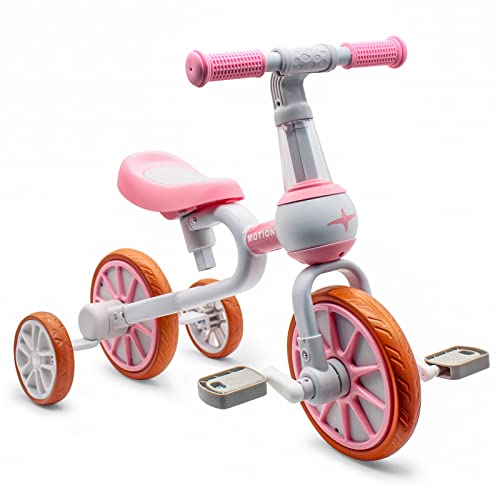
The XIAPIA 3-in-1 Toddler Bike is marketed as a growth-ready option, with pedal mode, pedal-less balance mode, and training wheel support. The design supports kids from around 18-24 months into the 2-4 year range, adjusting as they gain strength and balance. A carbon steel frame provides durability and a damping function, paired with EVA wheels to absorb shocks on uneven surfaces. This combination makes it suitable for both indoor free time and outdoor exploration as a child progresses through stages of riding.
Assembly is straightforward, with most parts fitting together without extensive tools. The bike’s modular approach allows parents to tailor the riding experience to their child’s current abilities—starting with pedal-assisted stability and gradually moving toward independent balance. The 3-in-1 concept helps families extend the usable life of a single bike as a child grows, which can be a cost-effective choice for early riders.
JOYSTAR 12-Inch Kids Bike With Training Wheels

This 12-inch JOYSTAR model is built for kids ages 2-4, featuring a sturdy hi-ten steel frame and fork that withstands the bumps of early riding. It comes with a basket and a water bottle holder for added fun and practicality, plus a coaster brake for reliable stopping power. The chain guard protects little fingers, and the bike ships with removable training wheels, enabling a gradual transition to balance riding. Quick height adjustments via a release seat make it easier to adapt as your child grows a few inches taller.
Durability and safety are emphasized through a durable finish and designed-for-krowth geometry. The bike’s simple, low-maintenance design means families can focus on ride time rather than frequent repairs. Assembly guidance notes that most components are pre-mounted, which helps new riders get rolling quickly and safely on the first ride.
JOYSTAR Little Daisy 12-Inch Girls Bike

The JOYSTAR Little Daisy offers a playful, princess-inspired design with a 12-inch wheel suitable for toddlers and preschoolers. It features a doll seat, a small basket, and removable training wheels to ease a child into balance riding. A front hand caliper brake plus rear coaster brake provides reliable stopping power, while the enclosed chain guard protects little fingers during rides. Adjustable saddle and stem height ensure a comfortable fit as your child grows, and vibrant colors help maintain interest and enthusiasm for riding.
Durable Hi-Ten steel construction and a simple, straightforward assembly process make this bike practical for families new to biking. The combination of safety features, decorative elements, and practical stability supports early riders as they learn to pedal, steer, and eventually balance without support.
Buying Guide
Age And Growth Potential
Look for bikes that cover broad age ranges (2-4 years or 18-24 months up to 3-4 years). Multi-mode designs—such as 2-in-1 trikes and 3-in-1 bikes—offer a smooth path from assisted riding to independent balance. Adjustable saddles and handlebars help accommodate growing children, reducing the need for replacements too soon.
Mode Versatility
Training wheels provide initial stability, while balance-bike modes promote balance and steering. 3-in-1 designs combine pedaling and balance activities, enabling longer use as a child progresses. A bike that can evolve with your child’s abilities often delivers the best value and longest usability.
Adjustability And Fit
Seat height, handlebar position, and pedal options should be easily adjustable. A quick-release seat makes height changes fast, while removable components allow parents to tailor the ride to the child’s current skill level without buying new bikes.
Safety Features
Essential safety features include enclosed chain guards, non-slip pedals, reliable braking systems (coaster brakes or hand brakes with help from a parent), and a sturdy frame. Training wheels should be stable and easy to remove as balance improves. Reflectors and bright colors also improve visibility in low light.
Durability And Materials
Kids’ bikes frequently encounter bumps and drops. Look for hi-ten steel frames, EVA foam wheels or sturdy rubber tires, and durable finishes that resist scratches and corrosion. A weight-capacity that comfortably exceeds the child’s weight is a plus for longevity.
Ease Of Assembly
Many models arrive partially assembled. Check for clear instructions, the number of tools required, and whether basic assembly tasks can be completed without professional help. Simpler assembly reduces frustration and speeds up the first ride.
Cost Versus Longevity
While price matters, prioritize bikes that offer growth potential. A model with 2-in-1 or 3-in-1 configurations may cost more upfront but save money over time by reducing the need for new bikes as children mature.
Summary: For two-year-olds, a bike with training wheels and an option to convert to a balance bike or a multi-mode design tends to provide the best blend of safety, skill development, and value. Consider the child’s current confidence, growth trajectory, and how the bike will be used—indoors, sidewalks, or parks—to pick the right option from the five featured above.