People seeking mobility solutions for daily tasks or companionship during outings can benefit from purpose-built scooters designed for safety, comfort, and stability. This guide highlights five top picks that balance power, ease of use, and practicality for adults, seniors, and handicapped riders. Each option offers unique strengths, from two-seat companionship to foldable designs for travel. Read on to compare features, safety elements, and portability to help make an informed choice.
| Product | Key Feature | Capacity |
|---|---|---|
| Dvsripa 2 Seater Electric Scooter | Two adjustable seats, 60V battery, 1000W motor | 500 lbs |
| Elifecenter 4-Wheel Red Folding Scooter | Lightweight, foldable, 13-mile range | 265 lbs |
| Elifecenter 4-Wheel Blue Folding Scooter | Easy disassembly, 13-mile range | 265-300 lbs |
| S&S Worldwide Spectrum 2-Person Scooter | Large twin-seat design, extra stability | Not specified |
| Pride Go-Go Sport 3 Wheel Mobility Scooter | Three-wheel design, easy disassembly | Not specified |
Dvsripa 2 Seater Electric Scooter

The Dvsripa two-seat mobility scooter is engineered for shared outings, featuring two comfortable, adjustable seats suited for seniors and adults needing heavy-duty support. With a 60V 20Ah battery and a 1000W differential brushless motor, this model achieves up to 15 mph and a practical range of up to 40 miles, meeting most short-travel demands. Safety is prioritized through a soft start controller, four-wheel drum brakes, differential motors for balanced turning, and waterproof charging ports to minimize rollover risk and electrical exposure.
Its robust build supports up to 500 pounds, making it a strong option for users requiring greater load capacity. The dual-seat arrangement fosters companionship and shared mobility without compromising control. While the higher power and capacity deliver enhanced performance, steering remains manageable with the provision of stable four-wheel handling and reliable braking. This model suits those who need a dependable, power-rich solution for longer local trips or care facility outings.
Elifecenter 4-Wheel Red Folding Scooter

This four-wheel folding mobility scooter is designed for both indoor and outdoor use. It offers a maximum speed of about 3.73 mph with an extended range of 13 miles, suitable for errands or light travel. The scooter safely supports up to 265 pounds, and its durable components include 8-inch flat-free tires engineered for reliability and safety. The heaviest pieces weigh roughly 30 pounds, and the device can be disassembled into five pieces for convenient storage or car transport, enabling easy trips to gatherings or clinics without heavy lifting.
The red model emphasizes portability and simple operation. With tool-free disassembly, a user-friendly control panel, and straightforward speed adjustments, this scooter prioritizes ease of use for seniors or caregivers. While it may not match heavy-duty motors in speed, it compensates with straightforward handling, compact folding, and practical weight distribution for daily mobility needs.
Elifecenter 4-Wheel Blue Folding Scooter

This blue variant shares the same folding architecture and safety features as the red version, designed for easy outdoor and indoor use. It safely supports 265-300 pounds, and the 8-inch flat-free tires support durability and stability on varied surfaces. A sensitive electromagnetic brake system enhances safety for seniors, and the scooter folds into five lightweight pieces, with the heaviest around 30 pounds, facilitating transport in a car trunk or backseat. The unit’s adjustable height seat and swiveling functionality support easy entry and exit for users with limited mobility.
Control is intuitive, enabling forward and reverse operation via lever and a speed dial. The packaging emphasizes versatility for daily errands, shopping trips, and casual outings while preserving a compact footprint when disassembled. This model blends portability and safety with dependable range for shorter trips, making it a practical choice for caregivers managing a mobility routine.
S&S Worldwide Spectrum 2-Person Scooter

The Spectrum 2-Person Scooter by S&S Worldwide is designed for shared mobility with a large 2-person seating arrangement. The generous deck and multiple handholds provide stability and support for two riders, enabling companionship during trips, recreational outings, or facility-based activities. The design focuses on providing ample space and a sturdy platform to accommodate various user needs while maintaining balance and control during movement.
Although specific weight capacity isn’t listed, the two-seat configuration emphasizes comfort and inclusivity, prioritizing safety and ease of use for both riders. The scooter’s size invites careful handling, storage considerations, and proper supervision, especially for transitions on uneven terrain or crowded environments. This option is suitable for scenarios where two riders share short-distance, supervised outings rather than solo travel.
Pride Go-Go Sport 3 Wheel Mobility Scooter
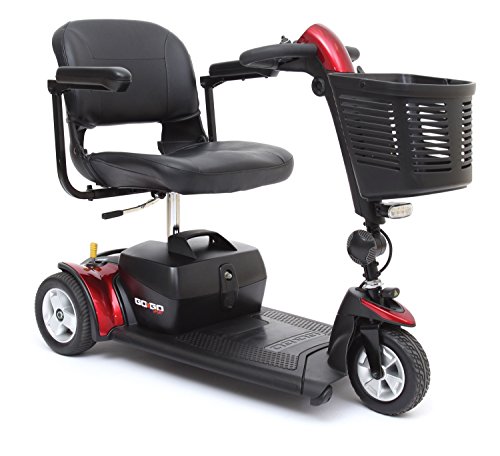
The Pride Go-Go Sport 3 Wheel Mobility Scooter focuses on ease of use and everyday practicality for seniors and handicapped users. It features feather-touch disassembly for simple transport and quick setup, making it a favorable option for travel, clinics, or social activities. The model includes customizable panels in Red and Blue, offering a degree of personalization to suit personal style or caregiver preferences.
This three-wheel design delivers a more compact footprint than four-wheel models, which can improve maneuverability in tight indoor spaces and around furniture. While it may trade some tracking stability for agility, it remains a solid choice for users prioritizing portability and quick setup for routine trips and visits.
Buying Guide: Key Purchase Considerations
When selecting a mobility scooter for handicapped users, consider these essential factors to ensure a safe, reliable, and comfortable experience:
- Weight Capacity and Rider Needs: Match the scooter’s weight limit with the user’s weight plus typical cargo. For shared seating or heavier loads, prioritize higher-capacity models like the 500-pound variant in the Dvsripa option.
- Power and Range: Assess motor wattage and battery capacity against daily travel distance. Higher power and larger batteries support longer rides between charges, especially for outdoor use.
- Stability and Handling: Four-wheel designs tend to offer better straight-line stability, while three-wheel models can offer tighter turning radii. Evaluate your typical environment—home, shopping centers, or outdoors.
- Portability and Disassembly: If frequent transport is needed, prioritize lightweight construction and tool-free disassembly. Look at the number of pieces and total weight when broken down.
- Safety Features: Soft-start controllers, reliable braking systems, electromagnetic brakes, and waterproof charging ports are important for minimizing risk. Consider lighting and reflectivity for outdoor use.
- Comfort and Ergonomics: Seat adjustability, swivel seats, and easy-to-reach controls reduce fatigue. Ensure seating supports correct posture for long durations.
- Maintenance and Availability: Availability of spare parts and ease of service influence long-term reliability. Check warranty terms and authorized service options in your region.
- Indoor vs. Outdoor Use: Indoor-friendly models prioritize compact dimensions and smooth floors, while outdoor variants require higher ground clearance and rugged tires.
In practice, choosing between a two-seat or folding option depends on companionship needs, travel frequency, and storage constraints. For caregivers, safety features and ease of operation carry equal weight to power and speed, ensuring confidence in daily routines and outings. A balanced assessment across these factors will guide the best fit for individual mobility goals.