Choosing the right motor controller is essential for reliable performance in mobility scooters, electric bikes, and similar electric vehicles. This guide reviews five notable controllers, highlighting compatibility, protection features, and ease of installation. Each option covers common voltages from 24V to 48V and supports various motor types, including brushed and brushless setups. The overview below helps readers compare options at a glance.
| Product | Voltage | Current | Motor Type | Notes |
|---|---|---|---|---|
| 1212P-2501 Motor Controller | 24V | 90A | Permanent magnet DC | Compatible with Curtis-style integrated vehicle controls |
| Brushless Controller with LCD Panel | 36V/48V | 350W (typical) | Brushless | Dual-mode control; LCD display included |
| L-faster 36V/48V Controller | 36V/48V | 1000W | Brushed | Scalable for tricycles and scooters |
| 24V/36V/48V Ebike Controller Kit | 24/36/48V | 500W | Brushless | LCD display; protections included |
| Maxmartt 500W Brushed Controller | 24V | — | Brushed | High-temperature protection; easy wiring |
1212P-2501 Motor Controller for 24V Systems

The 1212P-2501 is a 24V, 90A motor controller designed for permanent magnet DC motors. It is compatible with Curtis programmable integrated vehicle control systems commonly used in industrial carts, lifts, and pallet trucks. The controller emphasizes safety with forward/reverse and built-in safe brake alarm capabilities, aiding in multiple vehicle configurations. Its higher current rating supports robust performance on demanding loads, making it a solid choice for mid-range applications that require reliable torque delivery.
Brushless Controller With LCD Panel for E-Bikes and Scooters

This brushless motor controller supports 36V and 48V systems with 350W output. Its dual-mode control provides stable starting, smooth acceleration, strong climbing ability, and lower noise levels. The controller is designed to work with a variety of motor types, including sinusoidal and hallless configurations, and features a self-learning function. A waterproof LCD display panel is included to show essential data and system status, aiding user monitoring and diagnostics.
L-faster 36V/48V 1000W Scooter Controller

The L-faster controller is designed for 36V and 48V systems, delivering up to 1000W to support performance-driven scooters and trikes. It is a brushed controller suitable for several lighter-mallride platforms. The unit emphasizes straightforward installation and robust reliability, with clear wiring ports and standard protection features to help prevent damage from miswiring or overload. It suits riders seeking enhanced torque and dependable throttle response in mid-range builds.
24V/36V/48V Ebike Controller Kit with 500W Brushless Motor
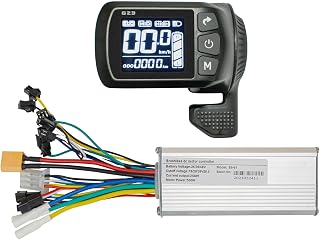
This 500W brushless motor speed controller handles 24V, 36V, and 48V systems with a compact LCD display that provides real-time metrics such as speed and battery level. It includes protection features like undervoltage and overcurrent protection to prolong motor life. The kit is suitable for electric bicycles, scooters, and light electric trikes, offering steady throttle control and reliable braking response for safer riding experiences.
Maxmartt 500W Brushed Speed Controller

The Maxmartt brushed speed controller emphasizes high-quality circuit board construction with features like high current protection and reverse polarity protection. It delivers strong torque and reliable operation for 24V brushed motors, with straightforward installation thanks to clearly labeled ports. The unit supports high heat dissipation and low-noise performance, making it a practical choice for electric bikes, scooters, and lightweight tricycles that rely on consistent throttle control.
Buying Guide: Key Considerations for Mobility Scooter Motor Controllers
- Voltage compatibility: Ensure the controller supports your system’s nominal voltage (24V, 36V, or 48V) to avoid underperformance or damage.
- Current and power rating: Match the controller’s amperage or wattage to your motor’s requirements to achieve optimal torque and acceleration without overheating.
- Motor type compatibility: Distinguish between brushed and brushless controllers. Brushless units generally offer smoother operation and longer life, while brushed controllers can be simpler and more affordable for basic builds.
- Protection features: Look for undervoltage, overcurrent, short-circuit, and reverse polarity protections. Overheat protection is also beneficial for sustained climbs and heavy loads.
- Control interface: Evaluate whether you need an LCD display, dual-mode control, or programmable options for speed, brake cutoffs, and reverse safety.
- Protection of braking and safety: Some controllers integrate braking cutoffs or safe brake alarms, which can be critical for pallet trucks, forklifts, and mobility devices in workplace settings.
- Ease of wiring and installation: Check for clearly labeled ports, standard connector types, and supportive documentation to reduce installation time and errors.
- Durability and environment: If exposure to water or dust is likely, consider IP-rated or weather-sealed controllers or those designed for rugged usage.
- Diagnostics and support: Availability of troubleshooting guides, firmware updates, and customer support can ease future maintenance.
- Compatibility with accessories: If you need to integrate LCD displays, throttle grips, or brake levers, confirm that the controller supports these peripherals and wiring standards.
In selecting a motor controller, it is important to balance performance with reliability. For industrial or heavy-use environments, prioritize higher current ratings, robust protection features, and compatibility with your specific motor type. For lighter consumer applications, a controller with an intuitive display and straightforward wiring can reduce setup time while still delivering solid throttle response and dependable operation.