Transform a mountain bike into an electric trail machine with purpose-built conversion kits that fit a range of frames. This guide highlights five high‑quality e‑bike kits designed for mountain biking, focusing on installation ease, power output, battery options, and compatibility with common disc brakes and frames. Each product links to its official Amazon listing in the product sections. Use the quick comparison table below to gauge key specs at a glance.
| Product | Brand | Type | Power | Wheel Type | Notable Feature |
|---|---|---|---|---|---|
| LIVALL PikaBoost 2 E-Bike Conversion Kit | LIVALL | Rear-Wheel Conversion Kit | 158Wh / 220Wh options | Rear wheel | App control; quick installation |
| BAFANG Mid Drive Kit BBS02B / BBS-HD | BAFANG | Mid-Drive Kit | 500W / 750W / 1000W | Bottom bracket 68–73mm | High torque; multiple power levels |
| Ringmaster 48V 1000W Rear Wheel Kit | Ringmaster | Rear-Wheel Kit | 1000W | Rear wheel | LED display; high efficiency |
| DDYOOK 48V 1000W Rear Wheel Kit | DDYOOK | Rear-Wheel Kit | 1000W | Rear wheel | Five-speed controller; LCD display |
| AW 48V 1000W Front Wheel Kit | AW | Front-Wheel Kit | 1000W | Front wheel | Thumb throttle indicators; disc/V-brake compatibility |
LIVALL PikaBoost 2 E-Bike Conversion Kit

The LIVALL PikaBoost 2 converts a bike’s rear wheel into an electric assist system with a streamlined installation that minimizes wiring. It uses a compact battery system available in 158Wh and 220Wh configurations, enabling ranges around 31 miles to 43 miles under favorable conditions. The kit emphasizes safety with a multi-layer Battery Management System (BMS) and supports quick switching between assisted and natural riding. An app interface provides ride data and configuration options, making it suitable for riders who want data insight and easy adjustments. Compatibility is limited to round seatposts in the 25–35 mm range, and a 65W USB-C charger is recommended for charging. Not designed for children’s bikes.
- Rear-wheel mounted with minimal wiring for clean setup
- Two battery options offering practical ranges for mountain trips
- App-based control and data logging for riders who track performance
BAFANG Mid Drive Kit BBS02B / BBS-HD

The BAFANG mid-drive kit delivers power through the bike’s bottom bracket, delivering high torque for challenging climbs and mixed terrain. Compatible with 68–73 mm bottom brackets and 100/120/160 N.m torque levels, it supports 33.5–36 mm inner diameters and 73 mm screws (not included). This kit is designed to upgrade MTBs, city bikes, and other disc-brake-equipped, chain-driven frames. It offers throttle, pedal assist, and standard cycling modes, with speeds up to 45 km/h. The kit is modular, with accessories like a display and battery option that can be added to taste, providing a scalable solution for serious riders.
- High-torque mid-drive performance for steep terrain
- Flexible fit across common MTB frames
- Multiple motor power options and riding modes
Ringmaster 48V 1000W Rear Wheel Kit

The Ringmaster rear-wheel kit equips a 1000W brushless, gearless motor with a high-efficiency design, delivering up to 26.72 mph and robust performance on mixed terrain. The kit emphasizes efficiency (over 82%) for extended rides and stable speeds, with a pedal-assist sensor that adapts to rider input and reduces throttle fatigue on long trips. A LED display and controller provide real-time ride data and system management. This setup is especially suitable for riders who want a straightforward rear-wheel upgrade with reliable performance and clear readouts.
- High-efficiency 1000W rear motor
- Detachable display and controller for monitoring
- Pedal-assist sensor integration for smooth power delivery
DDYOOK 48V 1000W Rear Wheel Kit

DDYOOK’s rear-wheel kit pairs a 1000W brushless motor with a user-friendly LCD display and a five-speed controller. The upgrade emphasizes a balance of power and control, enabling riders to reach up to 45–55 km/h while maintaining manageable acceleration and braking. The display provides real-time speed, battery status, and assist levels, helping riders optimize range on rugged routes. It’s designed for rear-wheel installation on suitable mountain bikes and supports compatibility with common disc and V-brake systems. The kit’s modular components support straightforward maintenance and potential upgrades.
- High-power motor with clear rider feedback
- Five-speed controller for adaptable assist
- LCD display for real-time system monitoring
AW 48V 1000W Front Wheel Kit
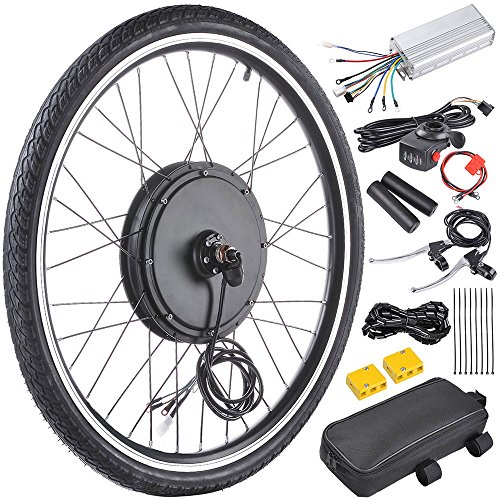
The AW front-wheel kit provides a front-hub motor upgrade with 1000W of power and a compact, durable design. Front-hub kits are typically easier to install on bikes lacking a dedicated bottom bracket for mid-drive systems, and this kit includes a thumb throttle with battery status indicators for quick checks on the go. It’s compatible with 26″ frames and supports both disc and V-brake configurations, making it a versatile option for mountain bikes seeking a straightforward conversion without altering the bike’s drivetrain. Installers should consider steering feel and weight distribution when choosing front-wheel power.
- Straightforward front-wheel installation
- Thumb throttle with battery indicators
- Disc/V-brake compatibility for versatile builds
Buying Guide
Choosing the right e-bike kit for a mountain bike involves balancing performance, compatibility, and practicality. The following considerations help buyers compare options across hub and mid-drive designs, front and rear wheels, and installation complexity.
Motor type and terrain suitability: Mid-drive kits like the BAFANG BBS02B/BBS-HD excel on steep climbs and technical terrain due to higher torque at the crank, leveraging the bike’s gears. Hub-motor kits (rear or front) offer simpler installations and cleaner cabling but may underperform on very steep grades when compared to mid-drive setups. For rugged mountain trails, prioritize mid-drive or high-torque hub systems for sustained performance.
Power level and torque: 750W to 1000W options deliver strong acceleration and climbing ability. Higher wattage often translates to more torque, but it can draw more battery power and add weight. Consider the typical riding terrain and the rider’s cadence preferences when selecting power.
Battery capacity and range: Battery size (Wh) directly affects range. If you frequently ride long descents or extended trails, choose kits with larger batteries or the option to upgrade. Battery efficiency and BMS design influence safety and longevity in off-road conditions.
Wheel type and mounting: Front-wheel kits are generally easier to install and may affect steering feel due to added weight on the front axle. Rear-wheel kits preserve steering dynamics but require careful alignment with the drivetrain and rear dropout spacing. Mid-drive kits require compatible frame bottom brackets and may entail more complex installation.
Frame compatibility and brakes: Many mid-drive kits require a specific bottom-bracket width (e.g., 68–73 mm). Wheel kits depend on dropout spacing, disc brake compatibility, and rim compatibility. Always verify your bike’s frame and braking system before purchasing a kit.
Installation and maintenance: Some kits offer quick installation with minimal wiring, while others require professional mounting, especially mid-drive systems. Consider future maintenance needs, availability of replacement parts, and local technician support when choosing a kit.
Display, controller, and software: A clear LCD or LED display helps monitor speed, range, and assist level. Apps that connect to the kit can provide ride analytics, firmware updates, and performance tuning, which is useful for riders who track metrics or tweak performance settings.
Safety and compliance: Confirm that the kit complies with local regulations and safety standards. Verify that the system includes reliable braking integration and protections against overheating or overcurrent scenarios during long climbs or hot-weather riding.
Warranty and service: Look for kits with reasonable warranty terms and accessible customer service or local technicians. Availability of spare parts and batteries can extend the life of a kit and protect your investment over time.