Finding the right bike for a seven-year-old involves balancing size, safety, and a growing sense of independence. The five bikes below represent beginner-friendly options, balance bikes for developing balance, and durable designs that can accompany a child as they progress. Each choice is suited to kids around seven, with different riding styles to match preferences—whether they want a BMX-influenced ride, a simple-to-ride cruiser, or a balance bike to master balance before pedaling. Use the quick table below to compare size, type, and suitability at a glance.
| Product | Brand | Size | Type | Age Range |
|---|---|---|---|---|
| Cubsala 18-Inch Freestyle BMX | cubsala | 18 Inch | BMX | 5-9 Years |
| WEIZE 16-Inch Kids Bike | WEIZE | 16 Inch | Standard | 4-7 Years |
| Ridego Balance Bike 12/14 Inch | Ridego | 12/14 Inch | Balance | 3-7 Years |
| GASLIKE 16-Inch Balance Bike | GASLIKE | 16 Inch | Balance | 4-8 Years |
| JOYSTAR 16-Inch Kids Bike Mint Green | JOYSTAR | 16 Inch | Standard | 4-7 Years |
Cubsala 18-Inch Freestyle BMX Bike

The Cubsala Crossea18 is designed as a friendly first BMX bike for young riders. It targets a height range of about 3’5″ to 4’3″, making it a good fit for many seven-year-olds who are growing into a slightly larger two-wheel experience. The frame uses Hi-Ten steel for reliable support and comfort, suitable for street, park, or light trails, with a 17.3″ top tube that keeps geometry approachable for new riders.
Performance and control come from a 152 mm one-piece crank paired with a 32T chainring, which provides predictable pedaling effort for smaller legs. Braking is handled by an aluminum U-brake and hand-brake levers, enabling more precise speed control as kids learn to modulate braking. This combination of sturdy construction and beginner-friendly components supports steady progression from training wheels to independent riding.
WEIZE Kids Bike, 16 Inch

The WEIZE 16-Inch Kids Bike is tailored for young riders aged roughly 4 to 7 years, with a recommended height range of 38″ to 48″. It emphasizes a rider-centric design, featuring smaller grips and a lightweight frame to simplify handling and control for beginners. A key safety feature is the full-coverage chain guard and a handbrake designed to be easy for small hands to operate. The bike’s geometry and components are chosen to minimize the learning curve while maximizing confidence on daily rides.
Parents will appreciate the focus on safety and ease of use, including height checks that help ensure the saddle and pedals are within reach for touch-to-ground stability. This bike is well-suited for kids transitioning from balance bikes or training wheels, providing a reliable step-up without overwhelming new riders with overly complex components.
Ridego 12/14 Inch Balance Bike for Kids 3-7

Ridego’s 12 or 14-inch balance bike is built to unleash your child’s adventure, with no pedals and no training wheels. Designed for ages 3 to 7, it helps develop balance and confidence before transitioning to a traditional pedal bike. The 14-inch option offers more stability for taller kids approaching the seven-year mark, while still keeping weight light and handling simple for small riders.
Equipped with all-terrain air rubber tires, the balance bike delivers a smoother ride on grass, gravel, or pavement. The frame is a glass-reinforced nylon design that balances strength with light weight, supporting riders up to about 110 pounds. This setup encourages kids to master steering, balance, and confidence in a low-stress environment.
GASLIKE 16-Inch Balance Bike

The GASLIKE 16-Inch Balance Bike is designed for bigger kids ready for more challenge. Its triangular carbon steel frame emphasizes durability and safety, providing a sturdy base for a more confident rider. Large 16-inch pneumatic tires help absorb shocks across varied surfaces, delivering a smoother glide on sidewalks, lawns, or playground paths. This bike is marketed as ideal for kids who are ready to transition from smaller balance bikes to more grown-up riding, with a focus on balance development and control.
With a weight-conscious design and robust tires, this model supports longer adventures while keeping the balance-focused learning experience intact. The bike’s geometry is tuned to help older or taller kids refine balance and steering skills as they approach a pedaled two-wheeler.
JOYSTAR 16-Inch Kids Bike Mint Green
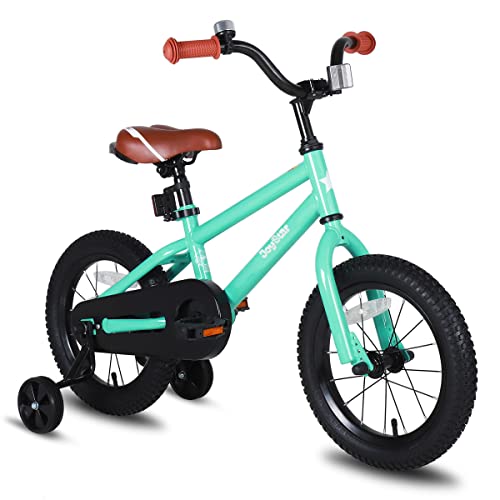
This JOYSTAR model is tailored for 4- to 7-year-olds, available in mint green and designed for easy growth. It features adjustable saddle and stem height to accommodate rising riders and a simple single-speed drivetrain for straightforward pedaling. The bike includes a durable steel frame and a coaster brake that provides simple stopping power, with a chain guard to keep clothing and fingers safe during learning.
Durability and a friendly aesthetic make this bike a popular choice for beginners and families seeking a low-maintenance ride. The included training wheels can help younger kids or those still building balance confidence, while the overall setup remains approachable for a first or second bike upgrade.
Buying Guide: Key Considerations And Comparisons
- Rider height and inseam: Measure your child’s height and inseam to match wheel size with reach. For around seven years old, 16″ bikes commonly fit kids between roughly 40″ and 50″ tall, while 18″ bikes suit taller first-time riders.
- Wheel size versus skill level: Balance bikes (12″–14″) are ideal for learning balance before pedaling. Once balance is steady, 16″ bikes help transition to pedaling with stability. An 18″ BMX can be a good option for kids who want more dynamic riding while still growing into the bike.
- Brake type and control: Coaster brakes are simple for beginners, while hand brakes offer greater precision. Consider dual braking (front hand brake and rear coaster) for learning control without sacrificing safety.
- Frame material and weight: Steel frames are sturdy and durable but heavier. Aluminum frames save weight for easier maneuvering, which can be helpful for younger or smaller riders.
- Adjustability: Look for bikes with adjustable saddle height and stem to accommodate growth. Quick-release clamps and simple height adjustments save time as kids grow.
- Safety features: A full chain guard, training wheels (if needed), fenders, and a safe, enclosed drivetrain reduce the risk of clothing catching and protect small fingers.
- Durability and maintenance: Check for reliable components (cranks, brakes, and tires) and the ease of routine maintenance. Bikes designed for beginners should require minimal upkeep to stay in good riding condition.
- Growth potential: Some bikes come with room to grow, offering longer top tubes or higher saddle positions. A model that scales with height can save money over time.
- Intended use: Consider where your child will ride most—neighborhood streets, parks, or trails—and pick a bike with appropriate geometry and tires for those surfaces.
- Assembly and warranties: Look for bikes that arrive with straightforward assembly and included tools. A warranty can provide peace of mind as kids ride and learn.