Indoor cycling has surged in popularity as riders seek precise, app-driven workouts that mimic real-world routes. This guide highlights five leading smart bike trainers that balance realism, quiet operation, and easy app integration. Whether you want feather-light setup, high-widelity power data, or immersive virtual courses, these models cover a range of preferences and budgets. Use the quick table below to compare essentials at a glance and then dive into detailed, objective overviews for each option.
| Product | Brand | Key Feature |
|---|---|---|
| ThinkRider X2Max Smart Bike Trainer | ThinkRider | Up to 2000W power; 18% tilt simulation; BLE/ANT+ support |
| Saris H3 Plus Smart Indoor Trainer | Saris | Quiet operation (~59 dB); 12-speed drive compatibility; virtual training app |
| Tacx Flux S Smart Bike Trainer | Tacx | Power within 3% accuracy; near-silent direct-drive |
| Garmin Tacx Neo 2T | Garmin | Foldable direct-drive with magnetic resistance |
| Saris Fluid2 Indoor Smart Trainer | Saris | Fluid resistance; USA-made; Zwift compatible |
ThinkRider X2Max Smart Bike Trainer

The ThinkRider X2Max integrates dual-mode BLE and ANT+ compatibility, supporting popular cycling software such as Zwift. It uses a DEPT dynamic electromagnetic torque power meter, delivering up to 2000W with a wattage accuracy of ±2%. An intelligent resistance system simulates an 18% tilt, and when connected to compatible riding software, it automatically matches tilt to the map, providing a realistic climb experience. The setup emphasizes broad device compatibility, enabling smooth pairing with tablets, phones, and PCs.
Performance hinges on precise power delivery and responsive resistance. The X2Max maintains consistent resistance curves even during sudden changes in cadence, helping riders maintain target zones. With a focus on realism, the trainer’s tilt simulation creates immersive climbs while preserving a quiet, house-friendly operation. The combination of power accuracy, tilt realism, and app integration makes it a strong option for FTP-focused training and virtual rides.
Saris H3 Plus Smart Indoor Bike Trainer

The Saris H3 Plus emphasizes quiet operation, rated at 59 decibels, and is noted to be five times quieter than earlier models. It pairs smoothly with 12-speed drivetrains, broadening bike compatibility and ensuring a realistic gear-range experience. An included virtual training app subscription enhances the training ecosystem, offering guided workouts and virtual routes. Precision is a hallmark, with components designed to deliver accurate readings for power, speed, and cadence, yielding a training session with a margin of error around ±2%.
Designed for dependable, steady performance, the H3 Plus uses direct-drive mechanics to minimize drivetrain wear and maximize data fidelity. Its quiet operation makes it well-suited for apartment setups or shared spaces. By combining effective drivetrain compatibility, reliable data, and a robust software ecosystem, the H3 Plus supports consistent, data-driven riding across varied workouts and virtual environments.
Tacx Flux S Smart Bike Trainer
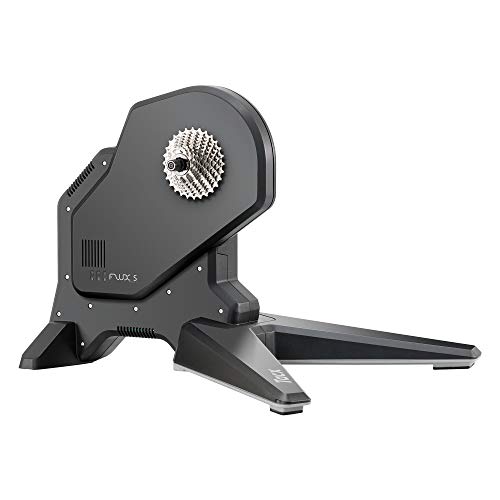
The Tacx Flux S offers a power measurement system with accuracy typically around 3%, focusing on a direct-drive, near-silent riding experience. It is compatible with popular third-party training apps, including Zwift and TacX’s own ecosystem, enabling diverse training scenarios from steady-state intervals to narrative climbs. The trainer emphasizes a stable ride feel with predictable resistance changes, allowing athletes to trust power data during virtual rides and structured workouts alike.
Direct-drive construction reduces wheel slip and provides efficient power transfer, contributing to a smooth, immersive workout. Profiling and calibration routines help maintain accuracy over time, while the compact footprint and straightforward setup appeal to riders with limited space. Overall, Flux S balances affordability with solid performance for regular, app-enabled training sessions.
Garmin Tacx Neo 2T Smart Trainer

The Garmin Tacx Neo 2T is a foldable, advanced direct-drive trainer designed for compact storage and easy transportation. Its resistance system uses magnetic technology with 32 neodymium magnets, delivering precise and repeatable power responses. While not relying on external power meters, its software integration and environmental calibration yield reliable data to support high-intensity workouts and virtual sessions. The foldable form factor helps maximize living space without compromising performance or data quality.
Durability and ease of use are central to the Neo 2T’s appeal. The foldable design reduces bulk for home gyms, and its electronic resistance offers consistent, low-noise operation that suits late-evening workouts. For riders seeking a premium, space-conscious setup with strong app support, the Neo 2T stands out as a versatile choice for immersive training and progression tracking.
Saris Fluid2 Indoor Smart Trainer

The Saris Fluid2 combines fluid resistance with smart trainer capabilities and is proudly made in the USA. It provides a smooth, realistic ride thanks to its fluid mechanism, delivering a broad, progressive resistance curve that closely mirrors road riding. The unit is compatible with Zwift and other virtual platforms, making it suitable for both virtual and non-virtual training environments. The Flow of resistance is stable, and calibration routines help ensure consistency across rides.
In addition to performance, the Fluid2’s build quality emphasizes durability and reliability. The included accessories, such as a wheel riser block, training mat, and towel, offer a ready-to-train package for those who want a comprehensive setup out of the box. This trainer’s USA-made heritage and strong ride feel make it a solid choice for regular, data-driven workouts and virtual rides alike.
Buying Guide
Choosing the right smart trainer depends on how you ride, where you live, and what data matters most to you. This buying guide distills key considerations to help compare models without focusing on price alone.
- Direct-drive vs wheel-on: Direct-drive tends to offer higher power accuracy, quieter operation, and less drivetrain wear, but requires more setup and space. Wheel-on trainers are typically easier to mount and store but may introduce more noise and wear on your tire.
- Power accuracy and maximum resistance: Look for wattage range and tolerance (for example, ±2% or ±3%). Higher max watts support intense intervals, while tighter tolerances yield more dependable FTP benchmarking.
- Slope simulation and realism: Models with tilt or incline simulation create a more immersive climb experience. Consider whether tilt is simulated via software or mechanical resistance, and whether it matches your training goals.
- Noise level and ride feel: Quieter units are advantageous in apartments or shared spaces. Direct-drive often reduces noise; fluid and wheel-on systems may produce more audible hum or whir.
- App ecosystem and data fidelity: Ensure compatibility with your preferred apps (Zwift, Rouvy, TacX, etc.) and check data readings for power, speed, and cadence. Firmware update reliability matters for long-term use.
- Bike compatibility and mounting: Confirm compatibility with your bike’s rear dropout spacing and cassette. Some trainers require specific adapters or cassette removal. Wheel size compatibility (26-29″) is common, but verify.
- Space, portability, and storage: If space is limited, prefer compact or foldable direct-drive units and consider how easily the trainer fits into your home gym or closet.
- Warranty and support: Look for sellers offering solid warranty coverage and accessible support. Training devices involve moving parts that benefit from good service.
Use-case snapshots to guide your choice: For FTP-focused athletes seeking maximum data fidelity and climbing realism, prioritize direct-drive with high power capacity and strong app support. For casual riders or apartment dwellers, seek quieter, foldable models with robust software ecosystems and straightforward setup. If you want a balanced package that reduces wheel wear and delivers reliable data, a reputable direct-drive trainer with a broad app community is typically a safe bet.