Choosing a bike speedometer and odometer helps you track speed, distance, and ride time, while many models add GPS, backlight, calorie tracking, and water resistance. This guide highlights five top options for American riders, spanning wired and wireless sensors, auto start/stop features, and easy setup for road, mountain, and gravel biking. Each entry includes core stats, standout features, and who it fits best. The following summary table provides a quick snapshot, followed by in-depth product sections and a practical buying guide to help you pick the right model for your riding style.
| Brand | Model | Key Features | Connectivity | Notes |
|---|---|---|---|---|
| CATEYE | Velo Wired Entry-Level | Current/Max/Avg speed, distance, time, pace, clock; auto-stop; wired sensor | Wired | Beginner-friendly, durable |
| CYCPLUS | GPS Bike Computer | Dynamic GPS, ride stats, altitude, backlight | Wireless | Great for GPS data and long rides |
| CATEYE | Urban Wireless | Speed, distance, calories, odometer option, clock | Wireless | Smart odometer customization |
| Bikevee | GPS Wireless | GPS data, altitude, long battery life, backlight | Wireless | Balanced features for serious riding |
| Hilceriy | Wired Bike Computer | Speed, average, max, distance, calories, temperature | Wired | Multi-function with weather rating |
CATEYE Velo Wired Entry-Level Bike Computer

The Velo Wired model provides essential cycling metrics suitable for beginners. It displays current, maximum, and average speed, plus total distance, trip distance, elapsed time, pace arrow, and a clock. The device automatically handles pauses, stopping time and speed averaging when you’re stopped at lights or taking a break, which helps keep your ride metrics accurate without manual resets. A wired speed sensor provides dependable, interference-free readings, enhancing reliability on busy roads and trails. The listing highlights a three-year battery life, which emphasizes longevity in its marketing materials.
Designed for road, MTB, and gravel bikes, this unit is straightforward to set up with minimal fuss. It’s ideal for riders who want clean, reliable data without the distractions of wireless pairing or GPS navigation. Its simplicity makes it a strong first-choice for riders who value consistent statistics over advanced route analytics. While it may lack modern GPS features, its focused performance on core metrics remains useful for regular training and pace tracking.
CYCPLUS GPS Bike Computer With Auto Backlight

The CYCPLUS GPS Bike Computer emphasizes precise GPS positioning and detailed ride analytics. It tracks route data and displays ride time, distance, total riding time, total mileage, clock, and current altitude. An automatic backlight enhances readability in bright sun or during dawn and dusk rides, aided by a glare-free FSTN display and tempered glass that resists scratches. The device is IPX6 waterproof and powered by a large 1200 mAh battery, delivering more than 55 hours of operation on a single charge. This model suits riders who value route tracking and long battery life for extended trips.
Beyond basic speed and distance, the GPS capabilities enable more advanced training analysis and post-ride review. The backlight and durable construction support year-round use in varying weather. For cyclists who pursue data-driven insights or who ride in open country with few landmarks, GPS-based tracking can be a decisive advantage, though it’s less about ultra-precise wheel-based speed and more about overall route metrics and endurance monitoring.
CATEYE Urban Wireless Bike Computer

The Urban Wireless model combines speed and distance tracking with calorie counting and programmable odometer options. It displays current, max, and average speed, total distance, trip distance, elapsed time, calorie consumption, pace arrow, and a clock. A notable feature is the ability to manually set the odometer, preserving mileage data even when you replace the battery, which is helpful for riders who ride across multiple bikes. FlexTight Bracket mounting makes installation and adjustments quick and secure, enabling easy repositioning without tools.
With wireless connectivity and calorie-tracking capabilities, this model appeals to riders who want a simple, reliable computer that supports basic fitness metrics and mileage continuity across bike changes. It’s a practical choice for commuters or recreational cyclists who value straightforward data and a tidy, tool-free setup over more advanced GPS features or map-based navigation.
Bikevee GPS Wireless Bike Computer
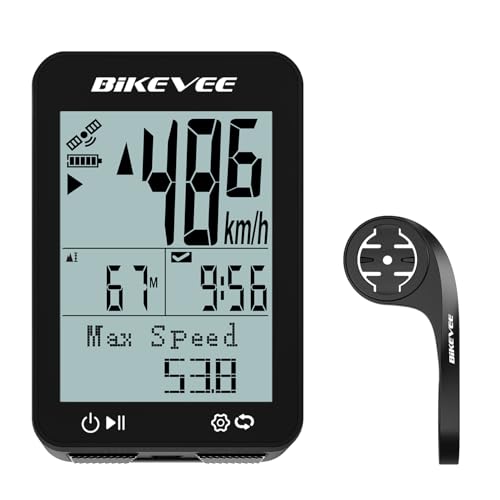
The Bikevee GPS Wireless model emphasizes professional data analysis and robust durability. It provides GPS-based metrics such as altitude, clock, speed in mph and km/h, trip time, trip distance, total time, total distance, average speed, and max speed, complemented by a readable 2.4″ LCD display and a bright backlight. Battery life is strong, with a 650 mAh capacity delivering up to 28 hours of operation. The device supports a five-satellite system (GPS, Beidou, GLONASS, Galileo, QZSS) for reliable positioning in cities and rural areas alike, and its IPX7 rating adds water resistance for wet conditions.
This model suits riders who want comprehensive analytics and dependable performance across diverse environments. It balances GPS-driven insights with a clear, legible display, making it a good option for endurance cyclists, commuters, and data-oriented riders who value long rides without frequent recharges. It’s especially attractive for riders who ride through tunnels or densely wooded routes where satellite reception can fluctuate, thanks to its multi-constellation support.
Hilceriy Wired Bike Computer

The Hilceriy wired unit combines multiple metrics with practical durability. It measures speed, average speed, maximum speed, KM/h, riding time, and distance, and it also tracks calories statistics and temperature. The wired design reduces potential interference and generally offers stable performance in varied riding conditions. A backlight supports night riding, and it includes an automatic wake-up feature to engage the display when you start riding. The device carries an IPX6 rating, indicating solid water resistance for rain and wet routes, making it a dependable choice for year-round use.
This model targets riders who prefer a well-rounded, no-nonsense computer with a broad feature set—calorie tracking, environmental data, and robust weather resistance—without needing GPS. It’s well-suited for daily commuters, training cyclists, and weekend riders who want reliable core stats and extra data like calories and temperature to influence training decisions.
Buying Guide
Choosing the right bike speedometer and odometer involves weighing display readability, data depth, sensor type, durability, and how you plan to use the information. Below are key purchase considerations and how different models stack up against them.
Display Readability And Backlighting
- Screen size matters for quick glances during a ride. Larger displays improve readability, especially in bright sun or on wet roads.
- A backlight is essential for early morning or late evening rides. Look for models with an automatic or easy-to-activate backlight.
- Contrast and glare resistance help ensure data is legible in diverse lighting conditions.
Sensor Type: Wired, Wireless, Or GPS
- Wired sensors provide reliable speed readings with minimal interference but require installation of a physical wire along the frame.
- Wireless sensors reduce clutter and are easier to install, though they can face occasional interference or signal drop‑outs.
- GPS-based models provide route data, altitude, and mileage trends, but consume more battery and may have slower initial positioning in tunnels or dense urban canyons.
Battery Life And Charging
- Long battery life is crucial for extended rides and multi-day cycling trips. Rechargeable units with 28–55+ hours are common for GPS models.
- Some models advertise multi-year or long-life batteries, particularly in non-GPS devices; verify real-world performance for your cadence and ride length.
- Consider ease of charging and whether the device uses replaceable batteries or built-in rechargeable packs.
Durability And Weather Resistance
- Water resistance ratings such as IPX6 or IPX7 indicate protection against rain and splashes, but real-world exposure and cleaning will still affect longevity.
- Rugged construction and sealed housings help protect electronics during off-road use or harsh weather.
Mounting And Setup
- Mounting options vary; some devices use flexible brackets (like FlexTight) for quick adjustments, while others rely on traditional clamps.
- Ease of setup matters if you switch bikes or want to move the computer between handlebars. Wireless models typically install faster than wired ones.
Data Depth And Exportability
- GPS-enabled units often offer richer data, including altitude, ride routes, and comprehensive analytics for training.
- Some models support manual odometer settings, calories, and temperature tracking, which can be valuable for fitness and training logs.
- Check whether the device supports data export or apps that aggregate ride data for progress tracking over time.
Use Case And Rider Level
- Beginner riders typically benefit from straightforward speed and distance metrics with easy setup.
- Casual riders may appreciate calorie tracking and odometer memory when switching bikes.
- Serious cyclists and data-driven riders often prioritize GPS data, altitude, and multi-satellite tracking for performance analysis.