Choosing a GPS bike computer involves balancing navigation, battery life, screen visibility, and data connectivity. This guide reviews five top models—ranging from solar-powered powerhouses to compact, budget-friendly options—to help riders across road, mountain, and gravel pursue precise routes and performance insights.
| Product | Brand | Key Feature |
|---|---|---|
| Garmin Edge 540 Solar | Garmin | Solar charging, adaptive coaching, advanced navigation |
| COROS DURA Solar | COROS | 120-hour GPS battery, solar charging, dual-frequency GPS |
| iGPSPORT BSC300T | iGPSPORT | 2.4″ touchscreen, offline maps, Ebike friendly |
| GEOID CC600 | GEOID | Color screen, turn-by-turn navigation, WiFi/Bluetooth |
| Navihood L4 | Navihood | Ultra-thin, IPX7, GLONASS positioning |
Garmin Edge 540 Solar

The Garmin Edge 540 Solar combines compact design with robust GPS navigation, powerful coaching, and comprehensive data metrics. It features button controls alongside a responsive interface, enabling quick access on the fly. Targeted adaptive coaching helps tailor workouts to current performance, while navigation and smart connectivity suit riders who plan routes with power meters and heart-rate monitors. The solar-assisted battery design helps extend ride time for long days on the road or trail.
Battery life varies by mode to support varied usage. In demanding use, expect up to 26 hours, or up to 32 hours with solar charging in direct sunlight. In battery saver mode, you can reach up to 42 hours, or 60 hours with solar. Solar charging can add roughly 25 minutes of runtime per hour during daytime rides in saver mode, helping endurance events and multi-day trips run more smoothly.
COROS DURA Solar

COROS DURA Solar delivers exceptional battery longevity with 120 hours of GPS use on a single charge, plus solar charging that extends ride time in direct sunlight. The 2.7-inch MIP color touchscreen remains readable in bright conditions, and the dual-frequency GPS improves positioning accuracy across varied terrain. It supports popular mapping ecosystems like Strava, Ride with GPS, and Komoot, with fast data sync for efficient firmware updates and seamless data export.
Navigation includes turn-by-turn guidance and is designed for glove-friendly interaction, allowing riders to follow routes without needing a phone. The rugged build emphasizes durability for endurance riding, while the streamlined form factor reduces weight and clutter on the handlebars, making it suitable for long trainings and adventures alike.
iGPSPORT BSC300T
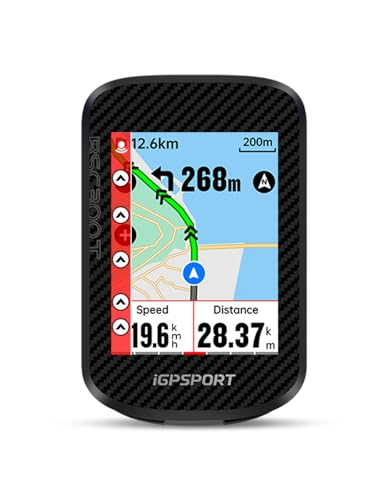
The iGPSPORT BSC300T provides a 2.4-inch touchscreen with six physical buttons for flexible control. It supports five satellite systems—GPS, Beidou, GLONASS, Galileo, and QZSS—ensuring fast and accurate positioning in diverse environments. It is Ebike compatible and can display power-related data, making it versatile for mixed-bike setups. Offline map navigation helps riders stay on course even when data connectivity is limited.
With offline navigation and an off-course warning, riders can trust the unit to alert them if they drift from planned routes. The combination of multi-satellite support, accessible navigation, and dual input methods makes the BSC300T a practical choice for riders who value independent navigation and straightforward operation on the trail or road.
GEOID CC600

The GEOID CC600 emphasizes a bright 2.4-inch color display with a simple three-button interface for quick access to routes and metrics. Its colorful route navigation includes turn reminders, while the ability to upload external GPX files via the phone app enables flexible course planning. Automatic re-routing helps you stay on track if you stray from the intended path, reducing the risk of getting lost on unfamiliar roads.
Connectivity is robust with WiFi and Bluetooth, facilitating rapid firmware updates and data transfers. AGNSS support improves satellite acquisition, especially in challenging environments. The CC600 blends an intuitive screen with reliable positioning, delivering dependable navigation without adding unnecessary bulk to the cockpit.
Navihood L4

Navihood L4 offers a minimalist, ultra-thin design with a laminated 2.3-inch screen and a compact 13.5 mm thickness. Its IPX7 waterproof rating ensures reliable operation in all weather, and automatic backlighting keeps the display readable in bright sun or low light. The device uses dual-system GPS positioning (GPS + GLONASS) for consistent data accuracy and quick cold-start times, making it ideal for entry-level riders who want dependable performance in a light package.
Weighing around 45 g, the L4 reduces handlebar clutter while providing essential metrics and navigation. Its simple setup and compatibility with common sensors make it a practical choice for beginners or riders who prefer a straightforward, no-fuss device that still delivers reliable GPS data.
Buying Guide
When selecting a GPS bike computer, buyers should weigh battery life, display usability, signal reliability, navigation capabilities, and ecosystem compatibility. A few key considerations can help guide the choice across different riding styles and budgets.
- Battery life and power options: Solar-powered devices like Garmin Edge 540 Solar and COROS DURA Solar offer extended runtimes, especially during long endurance rides. Consider whether you need ultra-long battery life for multi-day trips or if standard battery life with a portable charger suffices.
- Display readability and input method: Glove-friendly touchscreens, color displays, and the presence of physical buttons affect usability in sun, rain, or cold. If you ride in bright sun or conditions that require quick glances, prioritize high-contrast screens and robust input options.
- GPS accuracy and satellite support: Multi-constellation support (GPS, Beidou, GLONASS, Galileo, QZSS) improves positioning in urban canyons and dense tree cover. Dual-frequency GPS can offer additional precision in challenging environments.
- Navigation features: Turn-by-turn guidance, GPX import, and automatic re-routing are valuable for exploring new routes. Some models provide offline maps, which are essential when cell service is unreliable.
- App ecosystem and data sharing: Compatibility with Strava, Komoot, and Ride with GPS can simplify route planning and data analysis. Determine whether you prefer cloud syncing, firmware updates over WiFi, or Bluetooth transfers.
- Durability and water resistance: IP ratings (like IPX7) indicate how well a device handles rain and splashes. A rugged build helps during MTB or gravel rides where exposure to dust and mud is common.
- Size, weight, and mounting considerations: A lighter, thinner unit reduces handlebar clutter, while larger displays improve readability. Ensure the device is compatible with your bike mount setup and sensors (HR, power, cadence).
- Price-to-feature balance: Premium solar models offer long-term gas-to-value but come with higher upfront costs. Budget options provide essential navigation and data without extras; evaluate what features matter most for your riding style.
In practice, premium solar models such as Garmin Edge 540 Solar and COROS DURA Solar excel for endurance riders who value extended battery life, robust coaching, and advanced routing. Mid-range options like GEOID CC600 and iGPSPORT BSC300T provide strong navigation and multi-satellite support at a lower price point. Entry-level choices like Navihood L4 emphasize portability and simplicity while still delivering reliable GPS data for casual riders or beginners.