Answering the demand for comfortable, capable kids’ full-suspension bikes, this guide highlights options that balance safety, control, and value. The top picks are best for adventurous children ages roughly 6–12 who want better handling on rough terrain or dirt trails. Each pick is evaluated by suspend performance, braking, frame durability, and ease of use for young riders or beginners.
| Product | Brand | Best For | Key Feature |
|---|---|---|---|
| Ecarpat 24 Inch Dual Full Suspension Mountain Bike | Ecarpat | Teens and pre-teens seeking strong shocks and reliable brakes | Dual full suspension and 21-speed with disc brakes |
| DEYGIA 24 Inch Mountain Bike | DEYGIA | Youth riders tackling rough trails | Dual full suspension with dual disc brakes |
| WEIZE 20 Inch Kids Mountain Bike | WEIZE | Young riders needing manageable size and safety | Dual full suspension, 6 speeds, high-carbon steel frame |
| Glerc 20 Inch Kids Bike | Glerc | First-time riders who want reliable brakes | 21-speed drivetrain with front suspension and disc brakes |
| JOYSTAR Contender 20 Inch Bike | JOYSTAR | Young riders starting real mountain biking | Full dual-suspension steel frame with 1-speed drivetrain |
Ecarpat 24 Inch Dual Full Suspension Mountain Bike

Best for riders who need strong shock absorption and confident stopping power. This bike features a full suspension system designed to cushion rough terrain and a 21-speed drivetrain with mechanical dual disc brakes for reliable stops in varied conditions. Best for teens and taller kids who ride on mixed trails or urban routes with occasional bumps.
Who it’s best for: Riders aged roughly 10+ who want a solid, trail-capable bike and can manage a heavier frame. Why selected: It combines a robust steel frame with dual suspension and disc brakes to maximize comfort and control on uneven surfaces.
Caution: Heavier frame matters for younger children; ensure proper fitting and supervision when learning to ride on challenging terrain.
DEYGIA 24 Inch Mountain Bike
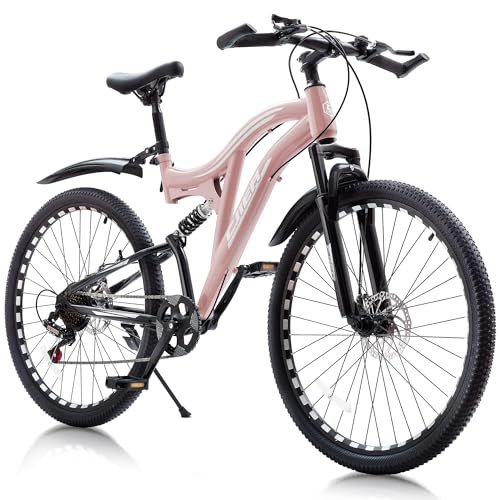
Best for adventurous teens who want maximum control on diverse terrains. It features a dual full suspension system and dual disc brakes for strong, dependable braking and a smoother ride over rocks, roots, or loose gravel. The 21-speed setup offers versatility for hills and flats alike.
Who it’s best for: Teens who mountain-bike on varied trails and value stable handling. Why selected: The dual discs and full suspension pair well for dampening shocks while maintaining effective braking.
Caution: The 21-speed system may require occasional adjustment; ongoing basic maintenance is recommended for peak performance.
WEIZE 20 Inch Kids Mountain Bike

Better for younger riders who need a manageable size and safer geometry. This bike offers dual suspension, a 6-speed drivetrain, and a durable high-carbon steel frame with a lower standover height, making mounting and dismounting easier for beginners.
Who it’s best for: Younger riders aged 6–12 who are growing into trail riding and need forgiving geometry. Why selected: Emphasizes safety and ease of use while delivering reliable suspension performance.
Caution: The 6-speed setup is modest; riders seeking more gear options on steep terrain may outgrow it quickly.
Glerc 20 Inch Kids Bike

Best for kids who want a versatile, entry-to-mid-level mountain bike with solid braking. The 21-speed drivetrain and front suspension offer good traction and control on variable surfaces, while disc brakes improve stopping performance in wet or dusty conditions.
Who it’s best for: Kids who ride on mixed surfaces and appreciate reliable braking and gear options. Why selected: Combines a sturdy frame with a broad gear range to handle hills and flats alike.
Caution: The 21 speeds add some maintenance needs; ensure periodic checks and proper shifting technique for young riders.
JOYSTAR Contender 20 Inch Bike

Choose this for a compact, capable entry into real mountain biking. The JOYSTAR Contender features a full dual-suspension steel frame, a single-speed drivetrain for straightforward operation, and a front fork plus rear spring shock to cushion bumps on trails.
Who it’s best for: Beginners and younger riders who want a straightforward setup with robust suspension for learning terrain handling. Why selected: A balanced, easy-to-maintain option that still offers true suspension benefits.
Caution: Single-speed design means limited gearing for very steep climbs; riders may need to push more on hills.
Buying Guide
- Age and height fit: Check the rider’s height range and reach. Look for bikes labeled for 46–56 inches tall or similar to ensure a comfortable pedal stroke and proper leg extension.
- Full suspension helps on rocky or rooty trails; consider rider weight, terrain, and frequency of off-road riding when choosing between front-only, rear-only, or full suspension.
- Disc brakes offer reliable stopping power in wet or dusty conditions, while V-brakes are simpler and lighter. Mechanical vs hydraulic disc brakes affect maintenance and performance.
- More gears help with hills and varied terrain. For beginners, a moderate gear range reduces shifting complexity while still enabling climb power.
- Steel frames are durable and forgiving; aluminum is lighter but often pricier. Confirm frame quality and weld durability.
- Puncture resistance and tread patterns influence grip on dirt, gravel, and wet surfaces. Ensure tires are appropriate for intended trails.
- Kids’ bikes require routine checks on brakes, gears, suspension settings, and wheel trueing. Plan for light maintenance tasks at home or with a bike shop.
Frequently Asked Questions
- What age is best for a full-suspension kids bike? Most models target riders aged 6–12, with height and inseam as key fit measures.
- Are full-suspension bikes harder to maintain for kids? They can require more frequent checks, especially for the suspension linkage and brakes, but many parts are straightforward to inspect and adjust.
- Is disc braking necessary on kids bikes? Disc brakes provide consistent stopping power in varied conditions; if budget or maintenance is a concern, hydraulic discs are not required—mechanical discs still perform well.
- How many speeds should a kid’s bike have? A range of 6–21 speeds offers a balance between climb ability and ease of use. Beginners often start with fewer gears and add as needed.
- What size bike should my child ride? Use height and inseam measurements. Most 20″ and 24″ wheel bikes fit riders in the 4’8″ to 5’3″ range, depending on geometry.
- How do I decide between a 20″ and 24″ bike? A 20″ bike suits shorter riders and beginners; 24″ bikes suit taller kids approaching adolescence who can pedal longer distances and handle bigger frames.