If you’re chasing a reliable way to prevent and repair flats on bikes, you’re in the right place. This guide highlights top-rated sealants and emergency inflators that work across mountain, road, gravel, and tubed setups. Best for quick roadside fixes, off-road riders, and daily commuters who want minimal downtime.
Quick buyer note: the right product depends on your tire type (tube vs tubeless), riding style, and willingness to carry a compact can or larger emergency kit. The table below summarizes the five top picks for bike tire maintenance and emergency repair.
| Product | Best For | ||
|---|---|---|---|
| Slime 10003 Bike Tube Puncture Repair Sealant | Tubed bicycle tires; quick seal | Tube sealant | 8oz bottle; up to 1/8″ punctures |
| Slime 10193 Tire and Tube Sealant | All tires incl. non-highway; long protection | Tire and tube sealant | 2-in-1; up to 1/4″ in tires |
| GUP Kwiki Quick Fix Tire Sealant and Inflator | On-the-go emergencies; tubeless and tube | Sealant and inflator | Push-button actuator; 122g can |
| GUP Kwiki Quick Fix Tire Sealant 2 Pack | Portable backup; multiple bikes | Sealant for tubeless/tubed | Hose top adapter; Schrader/Presta compatible |
| FlatOut QuickStrike Off-Road Formula | Off-road, tubed or tubeless; heavy use | Sealant with Kevlar | Seals up to 1/2″ punctures |
Slime 10003 Bike Tube Puncture Repair Sealant

Best for: riders who predominantly ride with inner tubes and want fast, simple puncture sealing. Slime 10003 targets punctures up to 1/8″ (3 mm) and works with an air source to prevent flats, delivering two years of protection. The product’s non-toxic formulation makes it friendly for everyday riders and casual cyclists who value ease of use.
Why selected: its Fibro-Seal Technology seals punctures as soon as air escapes, helping you ride away quickly. The 8-ounce bottle is compact for a rider who keeps a basic repair kit in a saddlebag.
Caution: for large holes or sidewall damage, the sealant may not be effective; only punctures up to 3 mm are guaranteed. Use with compatible air sources and recheck pressure after sealing.
Slime 10193 Tire and Tube Sealant Puncture Repair Sealant
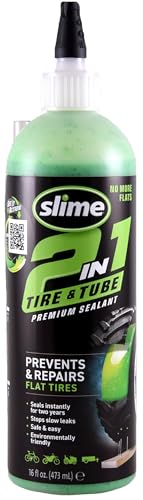
Best for: riders needing dual protection for tubes and non-highway tires, with an emphasis on off-road or mixed-terrain riding. This 2-in-1 formula protects and seals punctures in tires (up to 1/4″) and tubes (up to 1/8″), while also providing two years of continuous flat tire protection.
Why selected: its dual-action design targets punctures quickly as air escapes, forming a long-lasting plug. It’s a strong choice for riders who use both tubes and tubeless-compatible tires on varying surfaces.
Caution: larger tread-area punctures may exceed its sealing range; pre-installation to prevent punctures remains recommended for critical rides.
Fix-A-Flat S60420 Aerosol Emergency Flat Tire Repair

Best for: drivers and cyclists seeking a straightforward roadside emergency inflator and sealant for standard tires. The 16-ounce can is designed to seal small tread punctures up to 1/4 inch and provide enough inflation to lift the rim off the ground briefly.
Why selected: a long-standing option with a simple, one-step process to seal and inflate, making it suitable for quick roadside fixes. It’s a practical backup for cars and larger tires, as well as some heavier bikes with larger tires.
Caution: this product is an aerosol designed primarily for emergency use on standard tires; it may not be ideal for all bicycle tire setups, especially high-performance tubeless systems.
FlatOut QuickStrike Off-Road Formula

Best for: off-road enthusiasts who ride through rugged trails, mud, and rocky terrain. This formula emphasizes fast sealing and durability with Kevlar reinforcement for stronger puncture resistance.
Why selected: FlatOut QuickStrike is designed to seal tread-area punctures up to 1/2″ and address slow leaks more effectively in tubed and tubeless setups. The inclusion of Kevlar fibers reduces mess and improves longevity in demanding conditions.
Caution: primarily positioned for off-road tires; in lightly used street tires, some riders may opt for lighter formulations to avoid weight overhead.
Buying Guide: Key Considerations For Bike Tire Seals And Emergency Fixes
- Tube vs Tubeless: Choose sealants that are compatible with your tire type. Tubeless tires often benefit from heavier-duty sealants, while simple tube setups may prioritize quicker sealing for punctures up to 1/8″ or 1/4″.
- Puncture size and location: For hiking and trail conditions, look for products that seal larger punctures (up to 1/4″ or 1/2″) and even sidewall breaches in some formulations. Consider pre-sealing to prevent punctures for ongoing use.
- Application method: Push-button actuators and hoses improve on-the-go usability. Aerosol inflators offer quick inflation plus sealing, but weigh on-board space and pressure considerations.
- Longevity and protection: Two-year protection without reapplication is a common expectation. Review whether the product seals slow leaks and how often reapplication is needed after a puncture event.
- Safety and compatibility: Non-toxic, eco-friendly formulas reduce risk of skin contact and environmental impact. Confirm compatibility with your rim and valve type (Schrader vs Presta).
- Weight and portability: For racing or long-distance rides, a compact 4 oz can may be preferable, while off-road riders may opt for larger, more robust containers.
Frequently Asked Questions
- What is the difference between tube sealant and tubeless sealant?
– Tube sealants are designed to seal punctures in inner tubes, while tubeless sealants seal punctures in tubeless tires and can aid in sidewall damage in some cases. - Can these products fix all punctures?
– They work best on punctures up to certain sizes (commonly 1/8″ to 1/4″ or 1/2″). Larger holes may require a replacement tire or professional repair. - Do sealants damage rims or rims tapes?
– Most modern sealants are formulated to be safe for rims, but follow product instructions and avoid overfilling to minimize any potential mess or buildup. - Are there eco-friendly options?
– Several products advertise non-toxic and eco-friendly formulations, which are generally suitable for casual riders and environmentally conscious cyclists. - How long does a sealant last before replacement?
– Many options provide extended protection, commonly up to two years, but puncture-prone conditions or frequent use may require earlier reapplication. - When should I pre-fill sealant versus wait for a puncture?
– Pre-installing sealant helps prevent flats on tubes and some non-highway tires. For tubeless setups, check if ongoing leaks warrant resealing or topping off.