Power meters mounted on cranks deliver direct, left/right balanced power data for serious riders. This guide highlights five crank-based options that provide accurate, reliable performance across conditions, helping you train smarter and ride stronger. The top picks suit competitive road cyclists, multi-sport athletes, and data-driven enthusiasts seeking long battery life, rugged durability, and straightforward installation.
The following table summarizes the five featured crank-based power meters, including key strengths and ideal use cases.
| Product | Best For | Key Benefit | Approximate Battery Life Insight |
|---|---|---|---|
| GEOID PM500 170mm | Road racers and endurance riders | ±1.5% accuracy with dual-sensor fusion; IPX7 waterproof | Up to 300 hours per charge |
| Magene PES P505/P515 625g | All-around cyclists and long-distance riders | ±1% accuracy; lightweight, 7075 aluminum with triple hollow crank | Up to 380 hours ride time |
| GEOID PM500 165mm | Similar to 170mm, but different crank length | Same dual-sensor accuracy and build quality | Up to 300 hours per charge |
| Magene TEO P515 | Pro-level racers and high-speed training | Carbon crank with high stiffness; ±1% accuracy; 425g total weight | 380 hours plus efficient design |
| CooSpo Power Meter Crankset S10 | Easton 110 BCD users and value-focused riders | ±1% accuracy; dual-sided power and cadence data | Battery life up to 300 hours |
GEOID PM500 Bike Power Meter Crankset – 170mm
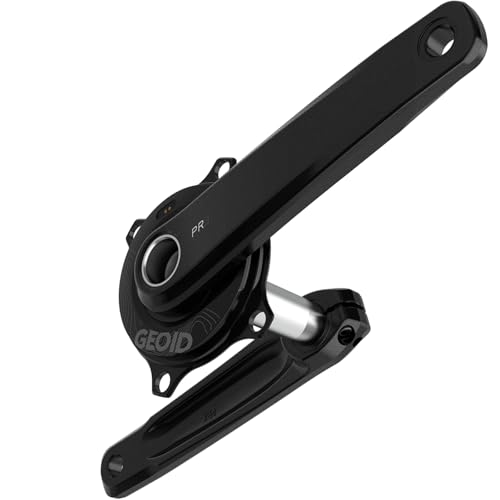
Best for riders who want strong accuracy and rugged reliability in a lightweight aluminum frame. This 170mm crankset uses a dual-sensor fusion algorithm combining strain gauges and an accelerometer to deliver ±1.5% power accuracy. It monitors ambient temperature in real time to correct measurement drift. The 680g weight includes a 100g spider, and the system supports 110 BCD. The 300-hour battery and magnetic charging offer long-term, hands-off operation. Best for road cyclists prioritizing dependable performance and weather resistance. Caution: data precision may vary slightly under extreme temperature swings or rapid accelerations.
GEOID PM500 165mm Bike Power Meter Crankset
Designed for riders who prefer a 165mm crank length, this configuration shares the same ±1.5% accuracy and robust build as the 170mm variant. It uses a 680g aluminum crank with a CNC-machined 7075 spider for stiffness and efficiency. A 300-hour battery life and magnetic charging ensure reliable, long-distance rides. Best for riders who need a slightly shorter crank to fit their biomechanics. Limitations include identical data precision constraints as other GEOID PM500 models under extreme conditions.
Magene PES P505/P515 Power Meter Crankset – 625g

Best for riders seeking a balance of light weight and durability. The PES P505/P515 uses ±1% power accuracy with a 7075 alloy crank and triple hollow design for stiffness, capable of withstanding high pedal forces. Battery life reaches about 380 hours in typical use, making it suitable for long training blocks. May be more expensive than entry-level options, but offers strong mixed-terrain performance and solid data reliability. Choose this if you value a robust, long-lasting system with precise measurements.
Magene TEO P515 Cycling Power Meter Crankset

Best for pro-level racers needing extreme stiffness and ultra-lightweight carbon construction. The TEO P515 combines HI-MOD carbon cranks (325g) with a 99g aluminum spider, delivering a total of 425g. It provides ±1% power accuracy and features dual ANT+/Bluetooth and IPX7 waterproofing. The design emphasizes rapid power transfer and race-ready performance, making it ideal for high-speed training and competition. Limitation: carbon-based components may require careful installation and torque management to maintain performance.
CooSpo Power Meter Crankset S10

Best for Easton 110 BCD users who want accurate, balanced power and cadence data in a versatile package. The S10 supports ANT+ and Bluetooth 5.0 for broad compatibility with devices and apps. It offers dual-sided measurement for comprehensive performance analysis. Battery life is around 300 hours. Best for riders who want reliable data and straightforward compatibility with a wide range of cycling computers. Limitation: may require verifying compatibility with your specific Easton crank model and install fit.
Buying Guide
What to consider before buying a crank-based power meter
- Crank length and compatible interfaces: Ensure the model offers the crank lengths you need (e.g., 165mm, 170mm) and fits your crankset’s BCD (e.g., 110 BCD).
- Power accuracy and data reliability: Look for power accuracy within ±1% to ±1.5%, and features like temperature compensation for stable readings in varying conditions.
- Battery life and charging: Longer battery life reduces downtime during training blocks. Check charging method (magnetic or standard) for convenience.
- Durability and water resistance: IP rating and chassis material influence performance in rain and rugged road conditions.
- Compatibility with devices: Confirm ANT+ and Bluetooth support to work with your bike computer, smartphone apps, and training platforms.
- Left-right power data: Decide if you want dual-sided power measurement or a simpler single-sensor solution based on training needs.
- Weight and stiffness: Lighter cranksets may improve acceleration. Crank and spider stiffness impact power transfer and feel.
How to choose between the options
- Best for budget-conscious beginners: Look for reliable accuracy with solid battery life, like GEOID PM500 variants.
- Best for endurance training: Favor models with the longest battery life and robust construction, such as Magene PES P505/P515.
- Best for weight-conscious racers: Consider Magene TEO P515 if carbon construction and ultra-lightweight are priorities.
- Best for compatibility with Easton crank systems: CooSpo S10 provides a versatile fit for Easton 110 BCD.
Quick tips for installation and maintenance
- Follow manufacturer torque specs during installation to avoid structural damage.
- Regularly inspect wiring and sensors for signs of wear or debris buildup.
- Periodically re-zero the power meter to maintain accuracy after maintenance or battery changes.
Frequently asked questions
- What makes crank-based power meters different from pedal-based ones? Crank-based meters measure torque directly at the crank, providing precise power data that’s strongly linked to pedal stroke and cadence. Pedal-based meters measure power at the pedals, which may introduce slight differences due to pedal spindle dynamics.
- Do crank-based power meters require calibration? Some models include automatic temperature compensation and automatic calibration; others may require occasional manual zeroing or calibration per manufacturer guidelines.
- Is dual-sided power data necessary for most riders? Dual-sided data provides detailed balance between legs and is valuable for serious athletes; casual riders may be satisfied with reliable single-sided data.
- Can I install these on any bike? Compatibility depends on crank length, BCD, and frame clearance. Always verify fit with your current crankset and frame before purchasing.
- How long does a battery typically last? Most models offer hundreds of hours per charge, with longer durations on models designed for endurance or efficient circuitry.
- Are carbon crank meters more fragile than aluminum? Carbon cranks can be more sensitive to impacts and torque, so careful installation and maintenance are important for longevity.