Answering the question “which bike trailer is best for off-road use?” this guide highlights sturdy, trail-ready trailers that manage rough terrain, loose surfaces, and heavier loads. Best fits include riders who venture onto gravel paths, light singletrack, or uneven firmer surfaces, plus those who need reliable cargo capacity. Below, five trailers stand out for off-road versatility, stability, and payload. A quick-reference table follows to help compare key specs at a glance.
| Product | Best For | Payload | Wheels | Notes |
|---|---|---|---|---|
| Burley COHO XC | Single-track adventures | Unknown | Single wheel | Coil-spring suspension for rugged terrain |
| VEVOR 275 lbs Trailer | Heavy gear on mixed surfaces | 275 lbs | 20″ wheels | Dual-wheel design for stability |
| VEVOR 160 lbs Trailer | Camping and daily hauls | 160 lbs | 16″ wheels | Strong frame, rust-resistant |
| Goplus 220 lbs Trailer | Grocery runs to off-road parks | 220 lbs | 16″ wheels | Reflectors, durable frame |
| Retrospec Rover Hauler | All-weather cargo on varied routes | 80 lbs | 20-29″ wheels compatible | Weather-resistant fabric |
Burley COHO XC Single-Wheel Off-Road Cargo Trailer

The Burley COHO XC is designed for off-road adventures with a single-wheel layout and coil-spring suspension. It targets riders who frequently encounter uneven trails and want smoother loads on narrow trails. Best for solo riders or light bike trips where a slimmer profile matters. The suspension reduces bouncing and helps stabilize gear on rough surfaces. A potential limitation is that a single wheel provides different stability characteristics than a dual-wheel trailer, which may affect load distribution on very steep terrain.
VEVOR Bike Cargo Trailer, 160 lbs

Best for riders who need a robust daily hauler with heavy payload potential. The 160 lb load capacity and industrial-grade steel frame provide solid stability on mixed surfaces, including light trails and pavement. 16″ tires with a powder-coated finish deliver durability and rust resistance. The trailer’s universal hitch adds compatibility with many bikes. Caution: heavier trailers can be harder to maneuver on steep or highly technical trails, and ensure your bike’s hitch capacity supports such loads.
VEVOR Bike Cargo Trailer, 275 lbs

Best for long trips or camping where you anticipate carrying heavy gear. The 275 lb high load capacity and dual-wheel design provide enhanced stability and traction across varied terrains. The 20″ wheels and carbon steel frame are built for durability, while the powder-coated coating resists rust. Choose this if you need a trailer that can haul substantial equipment; avoid this if you ride on extremely narrow trails where width could be an issue.
Goplus Bike Cargo Trailer

Best for versatile transport where moderate to heavy loads are required on mixed surfaces. The Goplus trailer supports up to 220 lbs and features 16″ tires that provide a stable ride across asphalt, gravel, and fields. A safety spring hitch and reflective elements enhance security. It can be a strong all-around choice for family trips and shopping hauls, but its single-axle design means care should be taken on very loose terrain or steep grades.
Retrospec Rover Hauler
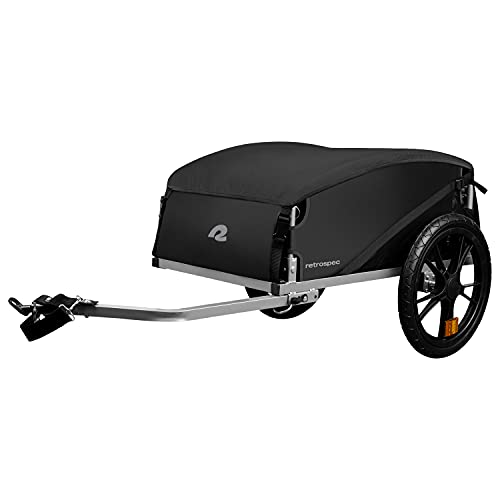
The Retrospec Rover Hauler offers weather-resistant fabric and an 80 lb capacity, ideal for all-weather cargo on mixed routes. Its compatibility with a wide wheel range (20-29″) makes it versatile for different bicycles. Best for budget-conscious riders who still want weather protection. The interior is adequate for groceries, gear, and light camping supplies. Limitation includes lower payload compared to larger trailers, so plan capacity accordingly for heavier trips.
Buying Guide
- Payload needs: Match trailer capacity to typical loads. Heavier loads require sturdier frames and, often, dual-wheel designs for stability.
- Terrain compatibility: Off-road use benefits from larger, rugged tires and suspension options. Single-wheel designs are lighter but can handle off-road if designed for it; dual wheels offer more stability on uneven ground.
- Bike compatibility: Check wheel size range and hitch compatibility. Some trailers fit a wide wheel range, while others require specific frame types.
- Durability and weather resistance: Powder-coated frames and weather-resistant fabrics protect cargo on rain, mud, and sun.
- Storage and transport: Consider foldability, weight, and how easy it is to store or move between vehicles.
- Safety features: Reflectors, safety straps, and locking or spring hitch features reduce cargo movement and improve trail safety.
Frequently Asked Questions
- What trailer is best for off-road cycling?
– Trailers with larger, rugged tires, suspension, and dual-wheel designs generally perform better on off-road surfaces. - How much payload should I look for in an off-road trailer?
– Choose a trailer with payload capacity that exceeds your typical cargo by at least 20–30% to account for terrain and maneuvering space. - Are single-wheel trailers suitable for rough trails?
– They can be, but stability and load distribution differ from dual-wheel designs. Best for lighter, narrower trails or where weight savings matter. - Can I use a regular bike trailer off-road?
– Some are built for off-road use; verify tire type, suspension, and hitch compatibility before attempting off-road rides with heavy loads. - What maintenance is needed for off-road trailers?
– Regularly inspect tires, hubs, and frame for wear; clean and dry after muddy or wet trips; lubricate moving parts as needed. - Are these trailers compatible with all bikes?
– Not universally. Check hitch type, bike frame width, and wheel size compatibility for each model.