Answering your search for reliable bike tire gauges, this guide highlights five top options that deliver precise readings for Presta and Schrader valves, with practical features for casual riders and serious cyclists alike. The best picks balance accuracy, build quality, and ease of use—ideal for daily commutes, road trips, or trail adventures. The following products are well-suited for: urban cyclists needing quick checks, bike shop enthusiasts who require dependable tools, and sport riders who demand consistent pressure readings in varying conditions.
| Product | Best For | Key Strength |
|---|---|---|
| ETENWOLF T300 Digital Tire Pressure Gauge | Everyday cyclists and DIY enthusiasts | Wide range, AI-assisted accuracy in extreme temps |
| AstroAI Digital Tire Pressure Gauge 0-150 PSI | Car, bike, and truck owners | Backlit display, multiple units, simple operation |
| Topeak SmartGauge D2 | Bike riders and motorcyclists | Presta/Schrader compatibility, high precision |
| ETENWOLF Pencil Tire Pressure Gauge 2 Pack | Spare or multi-vehicle setups | Dual range options, durable metal body |
| GEARYTE Presta Bike Tire Gauge 2 Pack | Presta-focused bikes and quick checks | Two-angle measurement, simple mechanical design |
ETENWOLF T300 Digital Tire Pressure Gauge

The ETENWOLF T300 is a digital gauge that covers a wide pressure range from 3 to 200 PSI, with ANSI B40.7 Grade 2A calibration and a ±1 PSI basic accuracy. Its internal AI-assisted chip offers thermal compensation to maintain readings from -4°F to 130°F. Best for cyclists who ride in varied weather and want a single gauge that handles both road and mountain tires. This model is especially suitable for riders who value consistent digital readings and a compact form factor.
Who it’s best for: riders who want digital readings with strong performance in extreme temperatures and a wide PSI range. Why selected: the gauge’s manual calibration to ANSI B40.7 Grade 2A and thermal compensation provide dependable results across conditions. Caution: Presta valve adapters are not included and must be purchased separately if you ride bicycles with Presta valves.
AstroAI Digital Tire Pressure Gauge 0-150 PSI
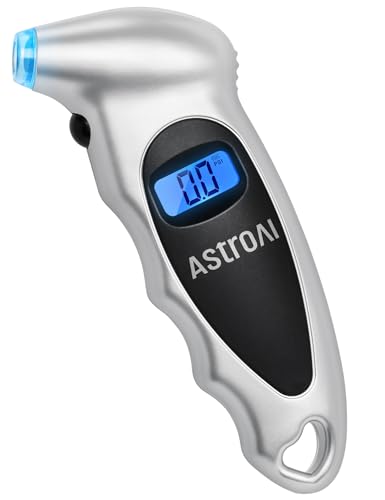
This AstroAI model offers a backlit LCD, four measurement units, and a simple one-button interface. Calibrated to ±1 PSI, it’s reliable for car and bike tires, with clear visibility in low light thanks to the backlight. It’s a practical choice for drivers who also want a versatile gauge for bikes, cars, or light trucks. Best for: drivers who want an all-purpose, easy-to-use digital gauge. Caution: It’s not specifically engineered for extreme weather beyond typical driving conditions; extremely cold temperatures may affect performance if used improperly.
AstroAI Pencil Tire Pressure Gauge 2 Pack

This two-pack pencil gauge from AstroAI provides a rugged, all-metal body with 10-75 PSI range and readings in PSI, kPa, and BAR. Its stainless steel construction helps resist rust and corrosion, making it ideal for frequent use on bikes, cars, and motorcycles. Best for: riders who want a compact, durable mechanical gauge with multiple scales. Caution: Do not exceed the gauge’s maximum pressure to avoid damage.
ETENWOLF Pencil Tire Pressure Gauge 2 Pack

This two-pack from ETENWOLF features two measurement ranges: 10-50 PSI and 20-120 PSI, with ANSI B40.1 Grade B calibration. It’s a solid all-metal gauge with stainless steel body and a zinc alloy head, designed for long-term use. Best for: cyclists who want a pencil-style gauge for various vehicles and a compact backup option. Caution: Requires manual alignment for accurate readings, particularly at the low end of the scale.
GEARYTE Presta Bike Tire Pressure Gauge Pencil 2 Pack

Gearyte’s pencil gauge is a two-pack, designed for use with Schrader or Presta valves, with a 10-120 PSI range and a durable stainless steel body. The dual-angle design allows for easier alignment on tight valve stems, and the analog dial provides quick, straightforward readings. Best for: riders who want a mechanical, adapter-free option for immediate checks on Presta and Schrader valves. Caution: The gauge requires careful, consistent valve seating to avoid inaccurate readings.
Buying Guide
- Gauge Type: Choose digital for quick, precise readings and data display, or mechanical for no battery dependence and rugged durability.
- Valve Compatibility: Ensure the gauge supports Presta, Schrader, or both. Pencil gauges often work well with tighter valve stems; digital gauges may require adapters for some setups.
- Pressure Range: Most bikes run 30-80 PSI; select a gauge that covers at least this range, with a higher max for versatility on other vehicles.
- Accuracy and Calibration: Look for standards such as ANSI B40.7. Manual calibration adds reliability, especially in extreme temperatures.
- Display and Readability: Backlit displays help in low light; large, clear numbers speed up checks on the road or trail.
- Durability and Portability: All-metal bodies offer rugged durability; pencil gauges are compact and pocket-friendly for on-the-go checks.
- Battery Considerations: Digital gauges require battery replacements; battery life and availability matter for frequent users.
- Ease of Use: Consider a gauge with a simple one-button design and universal valve compatibility to reduce user error.
FAQ
- Q: Do I need a special gauge for Presta valves? A: Many gauges support Presta valves, but some require adapters. Check the product specs for compatibility.
- Q: Are digital gauges more accurate than mechanical ones? A: Digital gauges often provide quick, clear readings with calibration to specific standards; mechanical gauges rely on a dial and can be very accurate when well-made and properly used.
- Q: Can these gauges measure air pressure for car tires? A: Some models have a wide PSI range suitable for cars; verify the maximum PSI if you plan multi-vehicle use.
- Q: How should I store a gauge to ensure longevity? A: Keep it in a protective case or pocket, avoid drops, and replace worn seals or nozzles as needed.
- Q: Do gauges require calibration? A: Digital gauges may retain calibration, but periodic checks against a known standard help maintain accuracy.
- Q: Which gauge is best for a frequent traveler? A: A compact pencil gauge or a digital model with a battery life and backlight is convenient for on-the-go checks.